
Before King, there was Jackson
J.H. Jackson was one of the most powerful and significant Black Baptist leaders of the twentieth century and most people don't know him.

Despite cultural polarization over Diversity, Equity, and Inclusion initiatives and the Department of Defense’s decision to no longer recognize “identity months,” February culturally remains Black History Month. As a historian of American religion, I can attest to the reality that you cannot understand the fullness of religion in the United States without understanding Black religion.
For most individuals, Black religion in the United States is captured best in the life and ministry of Rev. Dr. Martin Luther King Jr. From the Montgomery Bus Boycott to his “Letter from Birmingham Jail; from his “I Have a Dream Speech” to his sermon, “A Time to Break Silence” at the Riverside Church in New York City, King’s life and activism was shaped by his Baptist faith.
It is often difficult to explain to students in the twenty-first century that King was not a celebrated non-violent protester in the 1960s. The Federal Bureau of Investigation deemed King the “Most Dangerous Negro” in America and sent him mail claiming to have evidence of his extramarital affairs and urging him to kill himself. Even within the Black community, not everyone agreed with King’s tactics or approaches to the Civil Rights Movement. Within his own denomination, the National Baptist Convention Inc. (NBC), there were many who disliked him, perhaps none more significant than the denomination’s president Joseph H. Jackson.
While King is a household name today and Jackson far from well-known, in the 1950s Jackson was one of the most well-known Black leaders in the country. Even within the Baptist tradition, scholars and practitioners alike have a hard time understanding how to interpret and understand Jackson. I recently read Jared E. Alcantara’s The Challenge of Joseph H. Jackson: How America’s Most Powerful Black Preacher Became a Forgotten Man, a project that tries to address why Jackson became such a controversial and ultimately forgotten figure.
A Child of the Delta
J.H. Jackson was born in 1900 in the Mississippi Delta. While his family were landowners, they lived in one the poorest locations of the American South under the racism of Jim Crow. The Delta also had some of the highest percentages of Black residents of Mississippi, many of whom were sharecroppers.
Jackson’s family placed a high importance on education and religion. The Missionary Baptist tradition that Jackson was raised within rejected ecumenism and taught that only Baptists were orthodox and true Bible-believing Christians. Even other evangelical denominational groups like Methodists and Presbyterians did not practice true Christianity. Within this tradition, Jackson received a call to preach at the age of eight years old, and the church affirmed his call, licensing him shortly thereafter.
There were no public school options for Jackson to attend in his local community. He attended preparatory studies at Jackson State University (then Jackson College) before enrolling in the undergraduate program.
Before he had finished his undergraduate degree, he spent two summers studying at the University of Chicago School of Divinity. He wrote to Shailer Mathews, the school’s Dean and a Baptist, about summer studies and was rejected. When he arrived in Chicago determined to pursue his studies, Matthews made an exception.
Following his graduation from Jackson State University he received theological training from Colgate Rochester Divinity School. After accepting a call to pastor, a congregation in Nebraska he completed a master’s in education at Creighton University.
Becoming a Denominational Leader
In 1934, Jackson left his pastorate in Omaha, Nebraska to become the pastor of the second oldest Black Baptist congregation in Philadelphia, Monumental Baptist Church. After accepting this position, he accepted the role of General Secretary of the NBC’s Foreign Mission Board. It was in this role that Jackson honed his skills as a denominational leader.
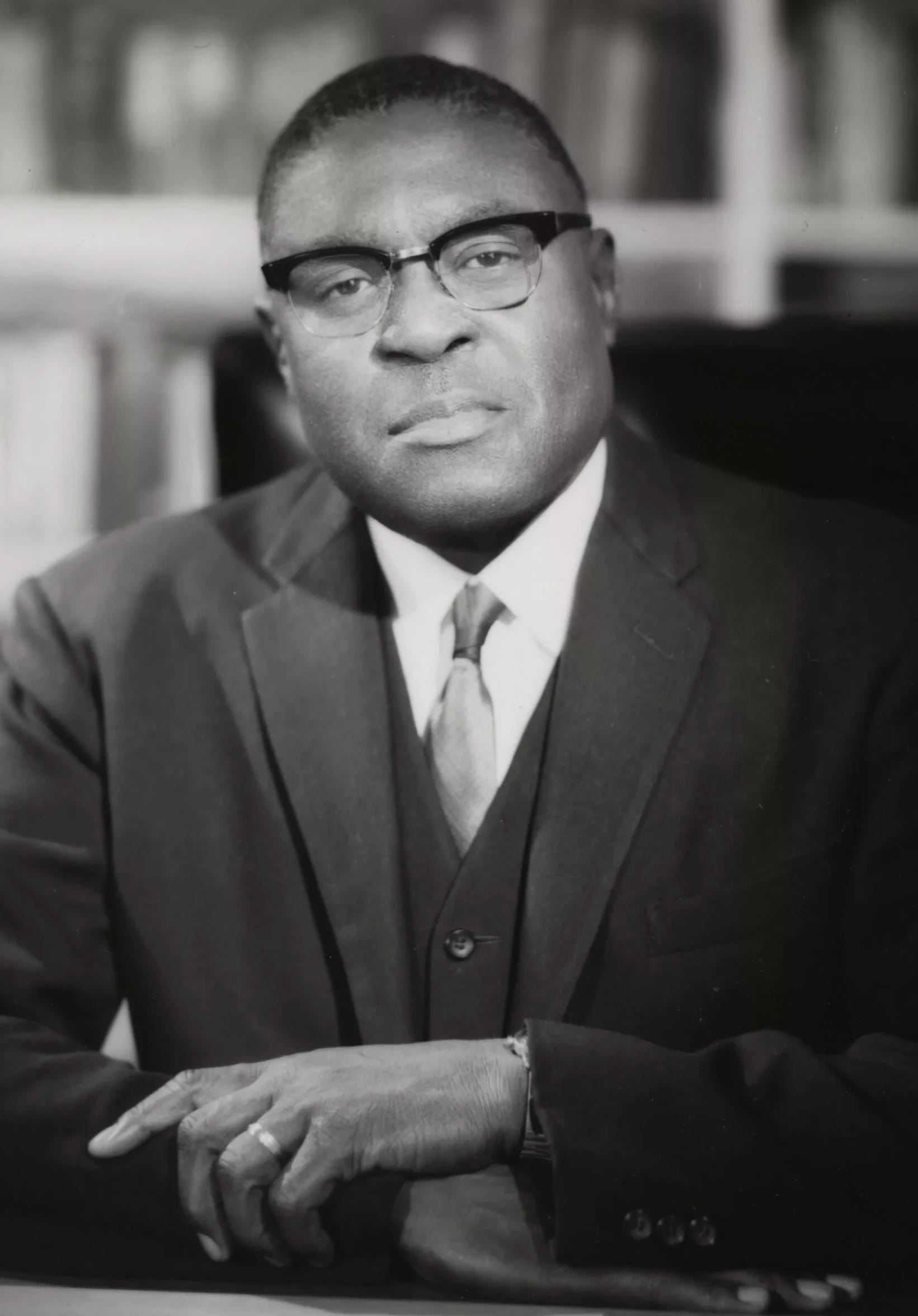
During the seven years he spent in Philadelphia leading Monumental Baptist Church and the Foreign Mission Board, Jackson worked to reorganize the way the NBC supported missionaries. He regularly traveled overseas, fostering ecumenical ties with other religious groups, and worked to raise money and reduce debt for the NBC. Before Jackson’s leadership, the Foreign Mission Board had not always operated in tandem with the NBC leadership. Jackson brokered compromise and trust between the two entities, bringing the Foreign Mission Board underneath the larger NBC organizational structure.
He conducted all of this work while leading a thriving congregation in Philadelphia, where he gained a reputation for being a powerful preacher. When he was not pastoring his congregation, he was attending international gatherings of religious and political leaders from around the world.
Despite Jackson’s growing notoriety within the NBC, he showed deference to the denomination’s organizational structure. He served under NBC President L.K. Williams who also pastored the Olivet Baptist Church in Chicago, one of the largest Protestant churches in the world at the time.
In 1940, NBC President Williams died unexpectedly in a plane crash, and there was speculation that Jackson might make a bid to succeed Williams. Jackson, however, deferred to denominational elders. He was only forty years old. Instead, Jackson allowed the mantel to fall to NBC Vice-President Rev. D.V. Jemison. As a consolation, Olivet Baptist Church, where Williams pastored, recruited and called Jackson to serve as their next pastor.
Jackson continued to defer to denominational elders until 1953 when an ailing and nearly blind NBC President Jemison decided to step aside. Aided by younger progressive Black pastors including MLK Sr. and MLK Jr. as well as Gardner Taylor, Jackson won election to the Presidency handily. He also ran on a platform that included tenure reforms to prohibit individuals from staying in positions for too long. He sought to usher in a new era of the NBC.
Holding onto Power
Jackson led the NBC much the way he had led the Foreign Mission Board and Olivet. He restructured the organization, raised money, consolidated and paid off debt, and fostered ecumenical and international relationships.
During the early days of the Montgomery Bus Boycott led by MLK Jr. Jackson worked to create support networks and King and participating congregations. Jackson was never outright supportive and the boycotts and would be remembered for his opposition to nonviolent resistance and civil disobedience, in these early days of his Presidency he was less vocal in his opposition to these tactics.
The new tenure policy of the NBC would have required Jackson to step aside after the 1957 election—after serving for four years as President. When this election came around, however, Jackson and his supporters worked to delegitimize this policy, paving the way for Jackson to continue serving as President. Consequently, a small group of members at Olivet had become disgruntled with Jackson’s leadership.
During the period from 1956-1958, Jackson worked hard to solidify his power and control. His understanding of church and denominational politics was unmatched. After a short conflict at Olivet, Jackson and the rest of the congregation excommunicated 300 individuals who had sought to unseat Jackson as their pastor, ridding the church of his opposition. Later he successfully had the tenure policy thrown out and was reelected as President of the NBC.
His political tactics frustrated his young supporters like MLK and Gardner Taylor. In 1960 and 61 Taylor made a bid for the NBC Presidency. At the 1961 gathering of the NBC in Kansas City, violence emerged over the Presidential election. As Taylor and Jackson fought for control of the microphone and the right to be able to address those assembled, Rev. A. G. Wright, a Jackson supporter in his sixties fell off the stage. Wright was rushed to the hospital but did not survive the injury to his brain. In the wake of Wright’s death, Jackson regained control of the gathering and won reelection.
In the weeks and months following the ‘61 Convention gathering, the conflict continued in the papers. It was apparent, however, that Jackson had won the convention. The Progressive National Baptist Convention Inc. (PNBC) was established in the wake of these events and would later welcome individuals like Taylor and King into its fold.
Jackson would go on to blame King’s tactics for the violence and disorder that resulted during the ‘61 convention. He would come to be seen as antagonistic towards the Civil Rights Movement, advocating for working within proper legal structures to advance the rights of Black Americans. Jackson led the NBC as President for 29 years until 1982 when he was quietly voted out for younger leadership. He remained pastor of Olivet Baptist Church until he died in 1990.
Jackson in Retrospect
Alcantara’s book is an important addition to the historical understanding of Jackson and his position in twentieth-century American religious history. Alcantara’s disciplinary background as a scholar of preaching, however, limits some of the project’s historical assessment. Some elements of the historical narrative are not altogether smooth, and some elements of the chronology are not connected well. He focuses a significant portion of the project on the first ten years of Jackson’s Presidency with the NBC Inc.
Perhaps the most under-analyzed element of Jackson’s life in the book is the element of gender. Only a few women are present in Alcantara’s biography. Primrose Funches is a member of Olivet Baptist Church who recruits and helps Jackson succeed Williams as Pastor. Jackson’s wife Maude and daughter appear sporadically, but other than this, there are almost no other women within his narrative.
Jackson’s clear consolidation of power within the NBC and unwillingness to step aside, seem like a story shaped by a commitment to a particular understanding of masculinity and power. The quest for the NBC Presidency became a literally violent struggle between men to control the fate of their religious denomination. As the denominational became structured around the Jackson, it provided a model and framework for other NBC congregations to consider the intersections of ministerial leadership and masculinity.
Although King has become a household name, Jackson is a reminder that the Black Church is not monolithic. If Alcantara’s book misses the intersection of race and gender in Jackson’s story, it does capture his complexity as a religious leader. Jackson’s leadership in the 1940s and 50s helped provide much-needed financial stability and restructuring to the NBC. He also brought the denomination into wider conversation with ecumenical partners and worked with political leaders.
If Jackson is remembered at all, it is most likely for his opposition to King and the Civil Rights Movement. Despite his many years of leadership following Kings assassination, he never regained the standing he once had the first few years of his Presidency. His tight grip on power seemingly overshadowed many of his successes, turning him into a forgotten religious leader from the mid twentieth century.
Please like, comment and share as you are inclined. If there is a topic that you would like me to write about or if you would like to collaborate, contact me at abgardner2@gmail.com